Google Built You a Page. Here's What It Costs to Take It.
Google now qualifies creators for a Search profile at 35,000 followers. What creators.google actually offers, how claiming works, and what it does and does not do for your search visibility.
If you visited creators.google a couple of years ago, you found a content marketing site: a quiz that recommended guides, articles about finding your niche, a nudge toward Web Stories. Google launched it in October 2021 as a rebrand of "Google Web Creators," and for most of its life it was a place to read things, not to do anything.
That site is gone in spirit. Today the page leads with a single instruction — shape how you show up on Google — and a button that checks whether you are allowed to. The library is still there in the margins (Search Console, Discover, a Discord). But the product is the Search profile, and the rest of the site is scaffolding around it.
This is worth understanding properly, because the thing Google is offering is stranger than a signup form. For a large number of eligible creators, the profile already exists. Google built it from your knowledge panel and your public accounts. Claiming it does not create a page; it transfers editorial control of a page Google wrote about you, in exchange for logging into your own social accounts in front of Google.
The facts, up front
- Search profiles launched — 4 June 2026, US first
- Thresholds lowered — 13 August 2026
- Qualify at — 35,000 followers on YouTube, Instagram or X
- Effect on rankings — none, per Google's own help documentation
- Team access — none; one Google Account per profile
What a Search profile actually is
A Search profile is a hosted page at profile.google.com that aggregates one identity across platforms: your photo, your bio, your links, and your latest content pulled from YouTube, Instagram, X and TikTok. Google describes it as "a dedicated, shareable space to highlight content across platforms."
It is not a ranking feature. It is a surface feature — the same underlying entity rendered in three different places, which is the part most write-ups skip.
The third box is the underrated one. The Discover route does not depend on ranking for a query at all. Someone taps Follow on your profile, and your new content lands in their feed. In an environment where AI Overviews sit between a query and a click, a follow-based channel inside Google's own app is a different kind of asset from a ranking.
Who qualifies now
At launch in June, the bar was high enough that most working creators were locked out: 100,000 followers on YouTube, Instagram or X, or 300,000 on TikTok. On 13 August 2026, Robby Stein, VP of Product for Google Search, announced a substantial cut.
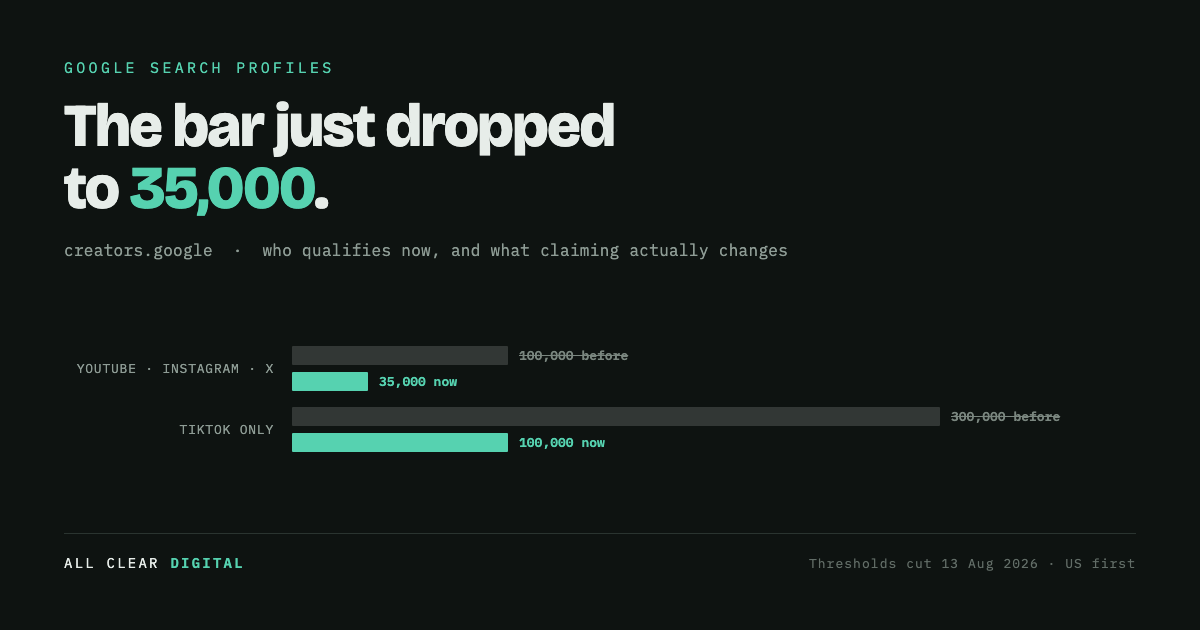
Check this yourself. Google's own help pages are not internally consistent on TikTok. The "Create a new Search profile" page and press coverage put the TikTok-only bar at 100,000; the "Claim an existing Search profile" page lists 35,000 across all four platforms. Assume 100,000 for TikTok until the eligibility checker at creators.google/profile tells you otherwise — and note that most third-party guides still quote the retired 100k/300k numbers entirely.
Eligibility, as of 8 September 2026
- Followers — 35,000 on YouTube, Instagram or X (was 100,000); 100,000 TikTok-only (was 300,000)
- Platform — the threshold must be met on a single platform. Audiences do not add up across four accounts.
- Account type — public profile; individual creators, publishers or organisations actively publishing
- Age — 18 or over
- Country — officially United States only. Profiles have been reported live in Brazil, Italy, Portugal, Spain and France; wider rollout is promised "later this year."
- Policy — subject to Google's content policies
The single-platform rule deserves a moment. If you have 20,000 on Instagram, 18,000 on YouTube and 12,000 on X, you have 50,000 followers and no profile. Google is not measuring your audience; it is measuring your concentration. That is a real strategic input for anyone within reach of the line.
Claiming it: the actual sequence
The flow is short, but it is worth seeing which steps are yours and which are Google's, because the asymmetry is the whole story of this product.
- Search your own name on Google. If a knowledge panel appears, click More → View Search Profile — a profile may already exist.
- Go to
profile.google.com/claimand sign in. If a YouTube channel is linked to the profile, use that channel's Google Account — this is the most common failure point. - Authenticate at least one qualifying social account. Link the others if they belong to the same identity; Google explicitly asks you not to attach accounts that are off-brand.
- Pin up to 8 featured posts and add up to 8 links. Your handle defaults to your most-followed account.
- Suggest edits to your name and bio if the generated version is wrong. These go into review rather than live.
- Come back for the insights panel: Google surfaces performance data for your content on Search and Discover inside the profile.
Operational gotcha. One Google Account claims one profile, and profile access cannot be shared or delegated. If you manage a talent roster or several brands, each needs its own account, and handing management to a colleague currently means handing over credentials. That is a poor fit for any agency or multi-person publisher, and it is the single most likely thing to change.
What you control, and what you only influence
Google's language throughout is careful. You claim, you suggest, you pin. The bio summary displayed in the knowledge panel is AI-generated, follower counts come from the platforms, and factual corrections are approved rather than applied.
None of this is unreasonable — an identity surface that anyone could rewrite freely would be a spam vector within a week. But it does mean the profile belongs in the same mental bucket as a Google Business Profile: a managed listing you steward, not a page you own.
Why Google shipped this
The timing is not subtle. Search profiles arrived in the middle of an ongoing argument between Google and the people whose content it summarises. AI Overviews have measurably reduced click-through on the queries they appear on — the figures cited in coverage range from a roughly 38% drop to around 61% on AI Overview queries, depending on the study and the query set — and publishers have spent 2025 and 2026 saying so loudly.
Google could not credibly promise publishers their clicks back. It could offer them a relationship that does not run through a ranking at all.
That is the honest read of this product. The Follow button in Discover is a subscription primitive inside Google's own app. It routes around the part of the funnel that AI answers have eaten. Whether that is a fair trade depends entirely on how much Discover traffic Google chooses to send you — which is, again, not something you control.
It also has lineage. Google shipped publisher profiles and Follow inside Discover in September 2025; Search profiles are that idea extended from publishers to individual creators and wired into the knowledge panel.
What it does and does not do for search visibility
It does not affect your rankings
Google says this plainly in the help documentation: creating a profile does not change how your pages rank. Anyone selling a Search profile as a ranking play is selling you something Google has already denied.
It does consolidate your entity
This is the part that matters. A claimed profile hands Google a verified, first-party mapping between one name, one photo, one website, and four social accounts. That is precisely the raw material the Knowledge Graph is built from, and entity confidence is what determines whether a system describes you correctly — in a knowledge panel, in an AI Overview, or in an AI assistant that leans on Google's entity data as a credibility signal. If you have ever watched an AI answer confidently attribute your work to someone with a similar name, this is the lever.
It may give you a link from a Google-owned domain
Several SEO write-ups have noted that outbound links on profile.google.com are currently followed rather than nofollowed. Treat that as reported rather than established: it is a detail that costs Google nothing to change, and a link-driven reason to claim a profile is the weakest reason to claim one. Claim it for the entity consolidation and the Discover channel; if the link is real, it is a bonus.
It opens a distribution channel with its own metrics
Followers, and a performance panel for Search and Discover inside the profile. Cross-reference that against the Discover report in Search Console, and watch for referrals from the profile URL in your analytics. If you claim a profile and never look at the numbers, you have done half the job.
If you are not eligible yet
Most people reading this will be under 35,000 on every individual platform. The useful response is not to wait — it is to build the entity signals that make a profile worth having when you cross the line, and that pay off in AI search regardless.
- Concentrate, don't spread. The threshold is per platform. Pick the one where you are closest and where your best content actually lives, and put your growth effort there rather than splitting it four ways.
- Mark up
sameAs. Add aPersonorOrganizationschema block on your site listing every social profile in asameAsarray. This is how Google connects the accounts to the website without a login. - Close the loop from the other side. Every social bio should link to your homepage. One-way links are weaker evidence than a round trip.
- Be one consistent entity. Same name, same handle, same photo, same one-line description everywhere. Entity resolution is pattern matching; give it an easy pattern.
- Publishers: check for a Discover profile. The publisher-profile path in Discover is separate and has historically been reachable at a lower bar, with a feedback form on the profile page for correcting missing social accounts.
The honest objections
It is a consolation prize, and you should price it as one. The profile does not restore the clicks that AI Overviews absorbed. It offers a different channel, on the same platform, governed by the same company, with the same discretion over how much traffic flows through it. Claiming it is sensible; treating it as a recovery strategy is not.
It increases your dependence. The strategic answer to a platform capturing more of your audience relationship is usually to build a channel it cannot mediate — email, a podcast feed, an app. A Google Discover Follow button is the opposite of that. Do it anyway if you qualify, but do not let it substitute for the owned channel.
The AI-generated bio is a real exposure. Google composes a summary of who you are and shows it beside your name. You can suggest corrections; you cannot write it. For anyone whose reputation is the product, that is worth checking on a schedule.
Name collisions will bite some people. Google says a profile may simply not produce a visible knowledge panel when other people share your name. If you have a common name, the profile still gives you a shareable page and the Discover relationship, but the headline benefit may never appear.
Documentation is still moving. The thresholds changed in August, two Google help pages currently disagree about TikTok, and country availability has outrun the official statement. Verify against Google's own eligibility checker before you act on any number in any article — including this one.
What to do this week
- Search your own name in an incognito window. Screenshot what Google currently says about you — that is your baseline.
- Run the eligibility check at
creators.google/profile. It takes a minute and settles the threshold question definitively. - If eligible, claim from the correct Google Account — the one tied to your YouTube channel if one is linked.
- Fill all 8 pins and all 8 links deliberately. Point at the pages you actually want ranked and shared, not just your homepage.
- Read the generated bio critically and submit corrections the same day.
- If not eligible, ship the
sameAsschema this week and pick the one platform you are going to push past 35,000. - Diary a check-in for 90 days: Discover impressions in Search Console, referrals from the profile URL, and whether the bio still says something true.
The framing that makes all of this make sense: a Search profile is not a marketing asset you are creating. It is a record Google is already keeping. The only decision on the table is whether you are the one editing it.
Sources
- Google for Creators and Search Profile
- Create a new Search profile and Claim an existing Search profile — Google Search Help
- A new profile to help publishers and creators highlight their work on Search — The Keyword, 4 June 2026
- Introducing Search profiles — YouTube Blog, 4 June 2026
- Google for Creators: Helping creators learn and grow — The Keyword, 20 October 2021
- Google lowers Search profile requirements — Social Media Today
- How Google Discover publisher profiles work — Search Engine Land
Frequently asked questions
What is a Google Search profile?
A Search profile is a claimable page at profile.google.com that aggregates a creator’s photo, bio, links, and latest posts from YouTube, Instagram, X and TikTok. It renders into the knowledge panel beside a name search, into Discover for people who tap Follow, and as a standalone shareable URL.
How many followers do you need for a Google Search profile?
As of the 13 August 2026 change, 35,000 followers or subscribers on a single platform — YouTube, Instagram or X — down from 100,000. TikTok-only creators qualify at 100,000, down from 300,000. The threshold must be met on one platform; audiences do not add up across accounts.
Does a Google Search profile improve your search rankings?
No. Google states in its help documentation that creating a profile does not affect how your pages rank. The real value is entity consolidation in the Knowledge Graph and a follow-based distribution channel in Discover that does not depend on ranking.
How do you claim a Google Search profile?
Go to profile.google.com/claim, sign in with your Google Account, and authenticate at least one qualifying social account. If a YouTube channel is linked to the profile, you must use that channel’s Google Account. Once claimed you can pin up to 8 posts, add up to 8 links, and suggest edits to your name and bio.